The table applies to moderate intensity (endurance, not race pace). Adjustments for high intensity and different disciplines are provided below.
| Temperature | Baselayer | Upper body mid-layer | Toplayer | Shorts | Extras |
|---|---|---|---|---|---|
| 20°C | transtex® light or light grid | Short-sleeved jersey | – | Cycling shorts / Bib shorts | Sunglasses, and arm UV protection if necessary |
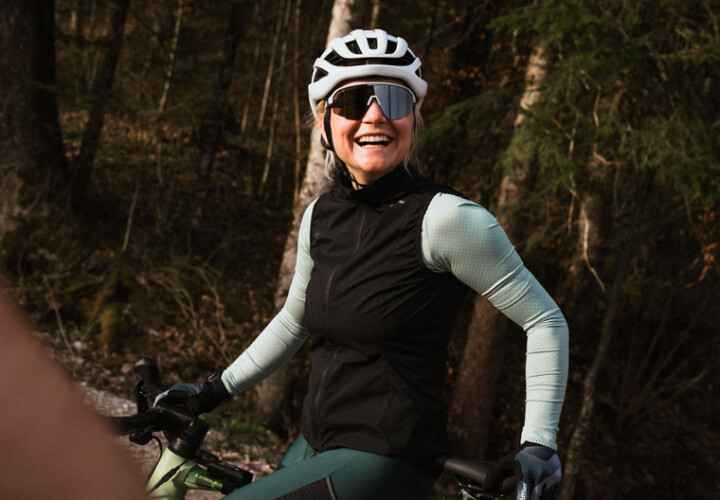
| 15°C | transtex® light 100 | Short-sleeved jersey | Windproof vest (packable) | Long cycling trousers or ¾-length tights | Thin gloves |
| 10°C | transtex® light 100 | Long-sleeved jersey or thermal jersey | Windproof vest | Thermo-Tight (0–10°C) | Fingerless gloves, headband |
| 5°C | transtex® warm 180 | Long-sleeved thermal top with full zip | Windbreaker / Airblocc Light | Airblocc-Tight or Thermo-Tight | Full-finger gloves, toe warmers / overshoes, hat |
| 0°C und kälter | transtex® warm 180 or Merino 200 | Long-sleeved thermal top with full zip | Airblocc Softshell or WPM-Jacket | Airblocc-Tight (−5–8°C) | Winter gloves, WPM overshoes, helmet liner |
Recommendation for moderate intensity (endurance pace). For high intensity, wear one layer less. Take individual sensitivity to the cold into account.
Quick tip: The colder it gets, the more layers you need – but the foundation always stays the same: a transtex® base layer next to the skin. This wicks sweat away mechanically, dries quickly and prevents you from getting cold after descents. On top of that, mid-layers and top layers adapt to the conditions.
Die Tabelle gilt für mittlere Intensität (Ausdauer, kein Renntempo). Anpassungen für hohe Intensität und verschiedene Disziplinen folgen weiter unten.
Kurzlogik: Je kälter, desto mehr Schichten – aber die Basis bleibt immer gleich: ein transtex®-Baselayer auf der Haut. Der transportiert Schweiß mechanisch nach außen, trocknet schnell und verhindert Auskühlen nach Abfahrten. Darüber passen sich Midlayer und Toplayer an die Bedingungen an.
Temperature alone isn’t the deciding factor. If you’re cycling hard, you generate significantly more body heat – and sweat more as a result. This changes what you need:
For high intensity (racing pace, hard intervals, steep climbs):
Fewer layers than indicated in the table above. Wicking takes priority over warmth. transtex® light or transtex® light grid as a base layer, no thermal jersey. A well-fitting wind vest is often sufficient down to 5°C.
At low intensity (commuting, leisure ride, long flat climb):
One extra layer. The body produces less heat. Here, transtex® warm is a good choice as a base layer, combined with a thermal jersey.
Rule of thumb: The higher the intensity, the more synthetic (transtex®). The lower the intensity, the more merino or transtex® merino hybrid.
| Temperature | Low intensity (commuting, leisure) | Moderate intensity (endurance) | High intensity (intervals, race) |
|---|---|---|---|
| 20°C | Base layer + lightweight jersey, or a vest if necessary | Base layer + short-sleeved jersey | transtex® light grid + short-sleeved jersey |
| 15°C | transtex® light + long-sleeved jersey + vest | transtex® light + short-sleeved jersey + vest | transtex® light + short-sleeved jersey |
| 10°C | transtex® warm + thermal base layer + jacket | transtex® light + thermal jersey + vest | transtex® light + long-sleeved jersey + vest |
| 5°C | transtex® warm + thermal jersey + Airblocc jacket | transtex® warm + thermal jersey + windbreaker | transtex® light + long-sleeved jersey + wind vest |
| 0°C | transtex® Merino 200 + thermal jersey + Airblocc | transtex® warm 180 + thermal jersey + Airblocc | transtex® warm 180 + thermal jersey + windbreaker |
Baselayer recommendation: The higher the intensity and the more you sweat, the more suitable transtex® light is. The lower the intensity, the more suitable transtex® warm or merino is.
Low intensity: Base layer + light jersey, possibly a vest
Moderate intensity: Base layer + short-sleeved jersey
High intensity: transtex® light grid + short-sleeved jersey
Low intensity: transtex® light + long-sleeved jersey + vest
Medium intensity: transtex® light + short-sleeved jersey + vest
High-intensity transtex® light + short-sleeved jersey
Low intensity transtex® warm + thermal top + jacket
Medium intensity: transtex® light + thermal jersey + vest
High intensity transtex® light + long-sleeved jersey + vest
Low intensity: transtex® warm + thermal leotard + Airblocc jacket
Moderate intensity: transtex® warm + thermal base layer + windbreaker
High intensity: transtex® light + long-sleeved jersey + wind vest
Low intensity: transtex® Merino 200 + thermal jersey + Airblocc
Medium intensity: transtex® warm 180 + thermal base layer + Airblocc
High-intensity transtex® warm 180 + thermal jersey + windbreaker
Dressed too warmly, with no way to take anything off. The first fifteen minutes feel cold – that’s normal. If you’re freezing at the start but haven’t brought any packable layers, you’ll start to overheat from kilometre 10 onwards. Solution: a lightweight, packable wind vest instead of a thick jacket.
Wrong base layer against the skin. A standard synthetic shirt or cotton base layer under your jersey traps moisture and cools you down. transtex® mechanically wicks sweat away to the outside without getting wet itself – you’ll feel the difference after 20 minutes.
Hands and feet underestimated. Extremities cool down faster than the torso. At 10°C, thin gloves and toe warmers are often not enough – full-finger gloves and closed overshoes are better.
Afternoon vs. morning ignored. A ride that starts at 8°C in the morning and climbs to 18°C by midday requires layers that can be removed. A vest in the back pocket, taking off the arm warmers – the outfit must allow for this.
At 10°C and moderate intensity: transtex® light base layer + long-sleeved jersey or thermal jersey + wind vest. Wear long cycling tights (thermal tights or long tights with a thermal lining). Gloves and closed-toe shoes. If you’re cycling at a high intensity, you can replace the thermal jersey with a standard short-sleeved jersey and a wind vest.
At 15°C, a short-sleeved jersey worn over a base layer is often sufficient, paired with long or three-quarter-length cycling shorts. A lightweight wind vest is a good idea for the first few kilometres or on descents. If you’re cycling at a high intensity, you can leave the vest off.
At 5°C, you’ll need three layers: a transtex® warm base layer + thermal jersey (long-sleeved, full-zip) + windproof jacket or Airblocc softshell. On the bottom, long cycling tights with a thermal lining or Airblocc tights. Full-finger gloves and overshoes.
Layering system with packable layers: base layer + jersey + lightweight, packable wind vest. The vest can be stowed in the back pocket when it gets warmer. Arm warmers are a great addition: put them on for a chilly descent, take them off when you’re warming up.
Thermo-Tights or long cycling tights with a thermal lining are ideal for temperatures of 10°C. The Löffler Bike Thermo Tights are specifically designed for temperatures between 0 and 10°C. If you feel the cold more easily or ride at a slower pace, you could also opt for Airblocc tights (designed for temperatures between −5 and 8°C).
Yes, always when temperatures drop below 15°C. A transtex® base layer keeps your skin dry by wicking sweat away from the body. This prevents you from getting cold on descents or in calm conditions – the single most important factor, especially on long rides.
When cycling, we travel through the air at speeds of 20–40 km/h – this significantly lowers the wind chill. At an outside temperature of 10°C and a cycling speed of 30 km/h, this equates to a wind chill of around 0°C. Windproof materials (Windshell, Airblocc) counteract this effect.