The best base layer for cross-country skiing: Which base layer is best suited to pace, cold weather and sweat?

The best base layer for cross-country skiing depends on the intensity of your activity, not just on the outside temperature.

LÖFFLER develops and knits functional underwear for cross-country skiing in Ried im Innkreis, Upper Austria. The transtex® ranges have been produced in the company’s own knitting mill since 1976, and LÖFFLER is the official kit supplier to the ÖSV Nordic division. The base fibre, polypropylene, absorbs zero per cent water and mechanically wicks sweat away from the body. This is exactly what matters in cross-country skiing, because you’re skiing for hours at a high heart rate whilst still being out in the cold.

How cross-country skiing differs from other winter sports

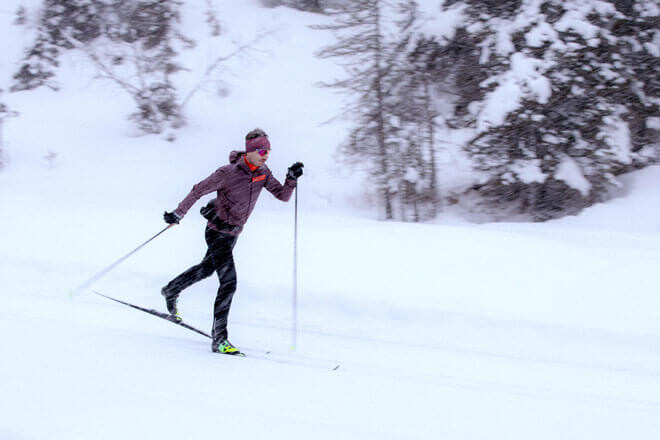
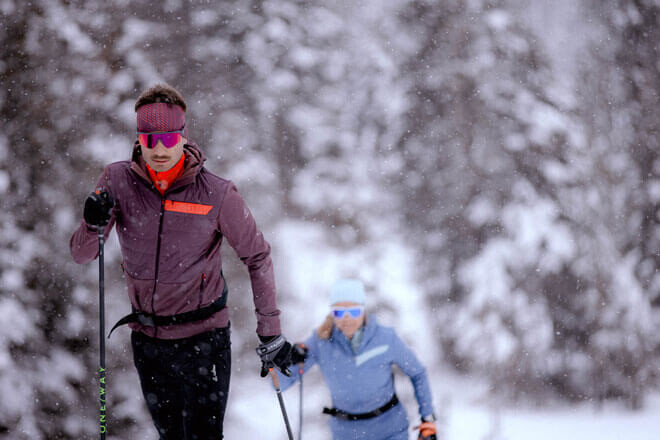
Cross-country skiing produces one of the highest sweat rates in endurance sports. You work your legs and upper body at the same time, and your heart rate remains high throughout the entire session. At the same time, you’re constantly interrupting the exertion: waxing breaks, waiting at the start of the trail, long descents.

This results in three requirements for the base layer:

  • Rapid moisture wicking under full exertion. A wet base layer will leave you feeling chilled on the first descent.
  • A snug fit without any air pockets. If the shirt is too loose, it won’t wick away moisture but will trap it instead.
  • Thermal performance during breaks, not whilst moving. The critical phase is when you’re stationary, not during intervals.

Cycling logic is only partly helpful here. On a bike, you generate a constant headwind; on a cross-country ski trail, this is absent over long stretches. That’s why you often sweat more heavily whilst cross-country skiing, even though the thermometer reads a lower temperature.

Many people choose their base layer based on how cold they feel at the start. After ten minutes, you’ll have warmed up to your working temperature; if your shirt is too warm, it will become saturated with sweat and then make you feel cold. Choose your base layer based on the intensity of the main exertion and take a jacket with you for the start.


Selection by intensity: the decisive criterion

The grammage of a fabric indicates its thermal insulation properties and also affects its breathability. The faster you’re moving, the easier it is to make the right choice.

High intensity: intervals, race pace, competition

  • Condition: You’re running at your limit, your heart rate stays above 85 per cent, and you’re sweating profusely.
  • Product: transtex® Light 100, long-sleeved (Item no. 23114 Men’s / 23144 Women’s, EUR 54.99).
  • Reason: The fabric is made from 100 per cent polypropylene at around 100 g/m². Polypropylene does not absorb water, and the structure of the knit wicks sweat away from the skin. The shirt dries extremely quickly and remains functional even after the third interval.

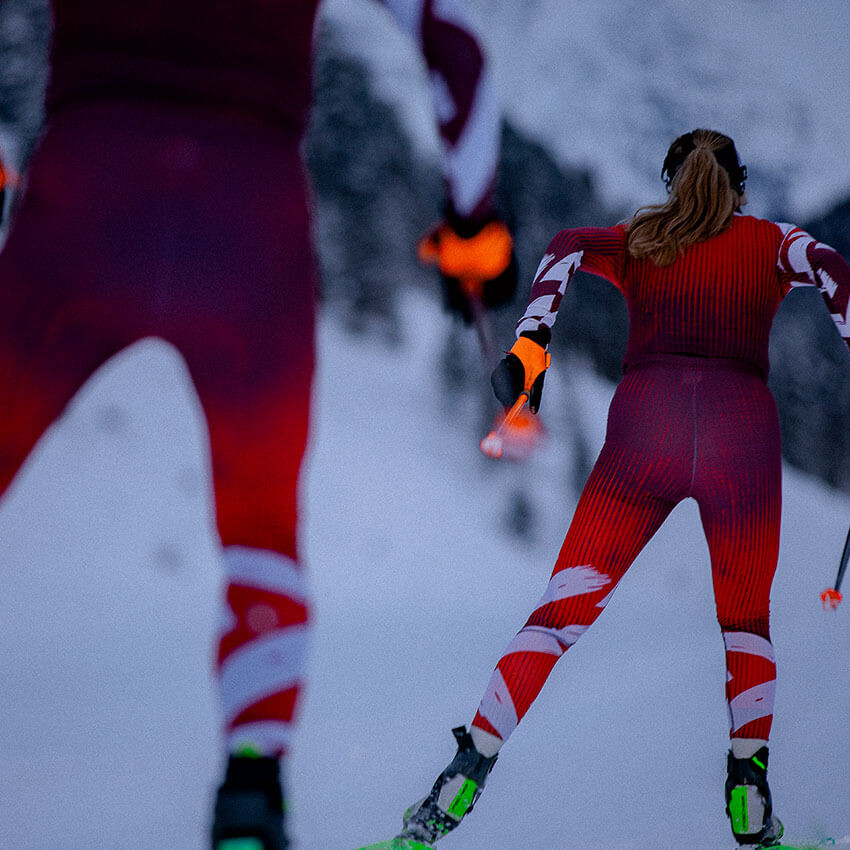
Under a racing suit, the short-sleeved shirt works better (item no. 22603 / 22605, EUR 49.99) or the singlet (item no. 22604 / 22606, EUR 44.99). Both reduce the number of layers of fabric on the shoulders and arms.

Moderate intensity: basic training, technique session

  • Condition: You are running at a steady pace within your base training zone; you are sweating noticeably, but not excessively.
  • Product: transtex® Warm 180, long-sleeved (Item no. 10732 Men’s / 10745 Women’s, EUR 69.99).
  • Reason: Warm 180 features a two-layer construction weighing around 180 g/m². The inner layer consists of polypropylene terry loops, whilst the outer layer, made of modal and cotton, absorbs moisture. This separation keeps the side against the skin dry whilst also retaining heat for when you take a break.

Low intensity: cross-country skiing tours, ski hiking, lots of time spent standing

  • Condition: You run at a leisurely pace, take breaks and cool down in between.
  • Product: transtex® Merino 200, long-sleeved (Item no. 27464 Men’s / 27462 Women’s, EUR 89.99).
  • Reason: The two-layer construction combines 63 per cent merino wool with 37 per cent polypropylene. The wool provides warmth when stationary, whilst the polypropylene manages moisture wicking during exertion. This blend is ideal for sessions with varying paces.
  • Basic rule: The higher the intensity, the more clearly synthetics come out on top. The lower the intensity, the more merino or a hybrid fabric demonstrates its advantages.

Klimaprofil Langlauf: Qualität nach Temperatur und Intensität

über +5 °C
Hohe Intensität (Intervalle, Renntempo)transtex® Light 100 Singlet oder Kurzarm
Moderate bis niedrige Intensität (Grundlage, Tour)transtex® Light 100 Langarm
+5 bis 0 °C
Hohe Intensität (Intervalle, Renntempo)transtex® Light 100 Langarm
Moderate bis niedrige Intensität (Grundlage, Tour)transtex® Warm 180 Langarm
0 bis −5 °C
Hohe Intensität (Intervalle, Renntempo)transtex® Light 100 Langarm, bei Wind mit winddichtem Frontbesatz
Moderate bis niedrige Intensität (Grundlage, Tour)transtex® Warm 180 Langarm
−5 bis −10 °C
Hohe Intensität (Intervalle, Renntempo)transtex® Warm 180 Langarm
Moderate bis niedrige Intensität (Grundlage, Tour)transtex® Merino 200 Langarm
unter −10 °C
Hohe Intensität (Intervalle, Renntempo)transtex® Warm 220 Langarm
Moderate bis niedrige Intensität (Grundlage, Tour)transtex® Merino 260 Langarm oder Turtleneck

Cross-country skiing climate profile: quality based on temperature and intensity

Temperature range High intensity (intervals, race pace) Moderate to low intensity (basic, tour)
above +5 °C transtex® Light 100 singlet or short-sleeved top transtex® Light 100 long-sleeved
+5 to 0 °C transtex® Light 100 Long-sleeved transtex® Warm 180 long-sleeved
0 to −5 °C transtex® Light 100 long-sleeved, with a windproof front panel for windy conditions transtex® Warm 180 long-sleeved
−5 to −10 °C transtex® Warm 180 long-sleeved transtex® Merino 200 long-sleeved
below −10 °C transtex® Warm 220 long-sleeved transtex® Merino 260 long-sleeved top or roll-neck

Dry cold and damp cold call for different responses

Two winter days with the same temperature reading present you with completely different challenges.

  • Dry cold, −5 to −15 °C, clear skies. The air barely draws any heat from you through evaporation at the surface of your clothing. This is where insulation counts. In very cold conditions and at a moderate pace, opt for transtex® Merino 260 (item 30805 men’s / 30793 women’s, EUR 119.99). This fabric combines merino wool with partially recycled polypropylene and is produced using seamless knitting technology, meaning there are no annoying seams.
  • Damp cold, −2 to +3 °C, snowfall or drizzle. These conditions cause you to lose the most heat. Moisture comes from both inside and outside at the same time. This is where polypropylene clearly comes out on top: the fibre does not retain moisture and therefore does not lose its insulating properties. Choose the transtex® Light 100 long-sleeved top and wear a windproof layer over it.
  • Wind on an open cross-country ski trail. A standard base layer does not protect you from the wind. The M Windproof HZ Shirt L/S transtex® Light 100 (Item 28162, EUR 99.99) features an elasticated, windproof trim at the front. It also has a stand-up collar, an extra-long front zip, thumb loops and an extended back. For racing kit set-ups, there’s the sleeveless version (item no. 27638, EUR 69.99).
  • Cold air around the neck. In very cold conditions, you breathe in large volumes of air and the collar determines your comfort. A turtleneck covers the neck without the need for an additional scarf: transtex® Warm 180 Turtleneck (item no. 13935, EUR 79.99) or transtex® Merino 260 Turtleneck

Product recommendations based on the situation

Intervalle und Renntempo, +5 bis −5 °C
Empfehlungtranstex® Light 100 Shirt L/S
Art.-Nr. Herren23114
Art.-Nr. Damen23144
UVPEUR 54,99
Wettkampf unter dem Rennanzug
Empfehlungtranstex® Light 100 Shirt S/S
Art.-Nr. Herren22603
Art.-Nr. Damen22605
UVPEUR 49,99
Rennanzug an wärmeren Tagen
Empfehlungtranstex® Light 100 Singlet
Art.-Nr. Herren22604
Art.-Nr. Damen22606
UVPEUR 44,99
Gegenwind auf offener Loipe
EmpfehlungM Windproof HZ Shirt L/S transtex® Light 100
Art.-Nr. Herren28162
Art.-Nr. Damen
UVPEUR 99,99
Wind, ärmellos unter dem Anzug
EmpfehlungM Windproof Singlet transtex® Light 100
Art.-Nr. Herren27638
Art.-Nr. Damen
UVPEUR 69,99
Grundlagentraining, 0 bis −10 °C
Empfehlungtranstex® Warm 180 Shirt L/S
Art.-Nr. Herren10732
Art.-Nr. Damen10745
UVPEUR 69,99
Kaltluft am Hals, 0 bis −10 °C
Empfehlungtranstex® Warm 180 Turtleneck L/S
Art.-Nr. Herren13935
Art.-Nr. Damen
UVPEUR 79,99
Sehr kalt, Fokus auf Komfort
Empfehlungtranstex® Warm 220 Shirt L/S
Art.-Nr. Herren30800
Art.-Nr. Damen30789
UVPEUR 99,99
Lange Touren mit Pausen
Empfehlungtranstex® Merino 200 Shirt L/S
Art.-Nr. Herren27464
Art.-Nr. Damen27462
UVPEUR 89,99
Sehr kalte Tage, moderates Tempo
Empfehlungtranstex® Merino 260 Shirt L/S
Art.-Nr. Herren30805
Art.-Nr. Damen30793
UVPEUR 119,99
Sehr kalt plus Kaltluft am Hals
Empfehlungtranstex® Merino 260 Turtleneck (Herren) / Tube (Damen)
Art.-Nr. Herren30806
Art.-Nr. Damen30794
UVPEUR 129,99
Ruhige Einheiten und Alltag
EmpfehlungMerino Light 130 Shirt L/S
Art.-Nr. Herren30804
Art.-Nr. Damen30797
UVPEUR 84,99
Komplettset für kalte Tage
Empfehlungtranstex® Warm 180 Set Long (Shirt und Hose)
Art.-Nr. Herren10735
Art.-Nr. Damen10748
UVPEUR 129,99

Product recommendations based on the situation

Situation Recommendation Art.-Nr. Men Art.-Nr. Women Price
Intervals and race pace, +5 to −5 °C transtex® Light 100 Shirt L/S 23114 23144 EUR 54,99
Competition under the racing suit transtex® Light 100 Shirt S/S 22603 22605 EUR 49,99
Racing suit for warmer days transtex® Light 100 Singlet 22604 22606 EUR 44,99
Headwind on an open cross-country ski trail M Windproof HZ Shirt L/S transtex® Light 100 28162 EUR 99,99
Wind, sleeveless under the suit M Windproof Singlet transtex® Light 100 27638 EUR 69,99
Basic training, 0 to −10 °C transtex® Warm 180 Shirt L/S 10732 10745 EUR 69,99
Cold air on your neck, 0 to −10 °C transtex® Warm 180 Turtleneck L/S 13935 EUR 79,99
Very cold, with a focus on comfort transtex® Warm 220 Shirt L/S 30800 30789 EUR 99,99
Long walks with breaks transtex® Merino 200 Shirt L/S 27464 27462 EUR 89,99
Very cold days, a moderate pace transtex® Merino 260 Shirt L/S 30805 30793 EUR 119,99
Very cold, plus a draught on my neck transtex® Merino 260 Turtleneck (Herren) / Tube (Damen) 30806 30794 EUR 129,99
Quiet sessions and everyday life Merino Light 130 Shirt L/S 30804 30797 EUR 84,99
Complete set for cold days transtex® Warm 180 Set Long (Shirt und Hose) 10735 10748 EUR 129,99

Material comparison: seven grades, seven areas of application

LÖFFLER categorises its functional underwear by grammage. This figure assigns each quality to a specific temperature and activity range. The climate profile provides a recommendation; you can adjust this up or down based on your personal sensitivity to the cold.

You can find the full comparison table in the table module on this page.

Summary for cross-country skiing:

  • transtex® Light 100 – your standard choice for everything from a basic pace upwards. Single-layer, 100 g/m², pure polypropylene.
  • transtex® Warm 180 – the choice for colder days when you’re pushing yourself to the limit. Double-layer, 180 g/m², terry loops on the inside.
  • transtex® Warm 220 – seamless knit, 220 g/m², with a slight compression effect (item no. 30800 men’s / 30789 women’s, EUR 99.99).
  • transtex® Merino 200 – high wool content for reliable performance in cold temperatures.
  • transtex® Merino 260 – the warmest option in the range, for very cold days.
  • Merino Light 130 – pure merino wool with 15.5-micron fine fibres, temperature-regulating, more suited to low-intensity sessions and everyday wear.

On odour: polypropylene inhibits odour without chemical treatments and without silver ions. Merino wool is naturally odourless. Both fibres are on a par in this respect – the difference lies in moisture management, not in odour.

Cotton is out of the question. Cotton absorbs sweat but hardly releases it. A cotton shirt worn under a cross-country skiing jacket will stick to your skin after twenty minutes and leave you feeling chilled during every break.

Comparison of materials: all seven grades

Quality Structure Composition Grammage (approximate value) Special feature Use according to climate profile
transtex® Light 70 single-layer PP 70 g/m² Grid structure Intense activity in warm weather
transtex® Light 100 single-layer PP 100 g/m² 3D-Structure Endurance and power all year round
Merino Light 130 single-layer WO / EL 130 g/m² 15.5-micron-thick wool fibre Naturally regulates body temperature
transtex® Warm 180 2-layer PP / CMD / CO / EL 180 g/m² Terry loops on the inside Full performance on colder days
transtex® Merino 200 2-layer PP / WO 200 g/m² High wool content Reliable performance in cold temperatures
transtex® Warm 220 2-layer PP / CLY / CO / PA / EL 220 g/m² Seamless knitting technology Optimal body temperature and maximum comfort
transtex® Merino 260 2-layer PP / PP rec. / WO / PA / EL 260 g/m² Seamless knitting technology A comfortable body temperature even in very cold conditions

Materialvergleich: alle sieben Qualitäten

transtex® Light 70
Aufbau1-schichtig
ZusammensetzungPP
Grammatur (Richtwert)70 g/m²
BesonderheitNetzstruktur
Einsatz laut KlimaprofilIntensive Aktivität bei warmen Temperaturen

transtex® Light 100
Aufbau1-schichtig
ZusammensetzungPP
Grammatur (Richtwert)100 g/m²
Besonderheit3D-Struktur
Einsatz laut KlimaprofilAusdauer und Power das ganze Jahr über

Merino Light 130
Aufbau1-schichtig
ZusammensetzungWO / EL
Grammatur (Richtwert)130 g/m²
Besonderheit15,5 Mikron dünne Wollfaser
Einsatz laut KlimaprofilReguliert das Körperklima auf natürliche Weise

transtex® Warm 180
Aufbau2-schichtig
ZusammensetzungPP / CMD / CO / EL
Grammatur (Richtwert)180 g/m²
BesonderheitFrotteeschlingen innen
Einsatz laut KlimaprofilVolle Performance an kälteren Tagen

transtex® Merino 200
Aufbau2-schichtig
ZusammensetzungPP / WO
Grammatur (Richtwert)200 g/m²
BesonderheitHoher Wollanteil
Einsatz laut KlimaprofilVerlässliche Leistung bei kalten Temperaturen

transtex® Warm 220
Aufbau2-schichtig
ZusammensetzungPP / CLY / CO / PA / EL
Grammatur (Richtwert)220 g/m²
BesonderheitSeamless-Stricktechnologie
Einsatz laut KlimaprofilOptimales Körperklima und höchster Komfort

transtex® Merino 260
Aufbau2-schichtig
ZusammensetzungPP / PP rec. / WO / PA / EL
Grammatur (Richtwert)260 g/m²
BesonderheitSeamless-Stricktechnologie
Einsatz laut KlimaprofilAngenehmes Körperklima bei sehr kalten Temperaturen

Cut and fit: the second part of the decision

The right quality is of little use to you if the fit isn’t right. When it comes to cross-country skiing, the rule is:

  • Close-fitting, but not constricting. The fabric needs to be in contact with the skin; otherwise, it won’t wick away moisture. All transtex® models feature a slim fit.
  • Flat seams at the shoulders and underarms. Rucksack straps and racing suits rub precisely in these areas.
  • Extended back. With a standard cut, a short shirt slips out of your trousers. The windproof models already feature this cut.
  • Raglan sleeves for full arm freedom. The double-pole push requires freedom of movement in the shoulders.

Wear the base layer directly against the skin. An extra layer underneath blocks moisture-wicking and renders the design ineffective.

Choosing a technique in cross-country skiing

Cut When it’s suitable sample model price
Tank top (sleeveless) Under the racing suit, on warmer days, for maximum ventilation transtex® Light 100 Singlet (Art. 22604 / 22606) EUR 44,99
Short-sleeved Competition and intervals above 0 °C, few layers of clothing transtex® Light 100 Shirt S/S (Art. 22603 / 22605) EUR 49,99
Long-sleeved Standard temperature range for training: between +5 and −10 °C transtex® Light 100 Shirt L/S (Art. 23114 / 23144) EUR 54,99
Turtleneck / Tube top From around −8 °C, strong wind, cold air on the neck transtex® Warm 180 Turtleneck L/S (Art. 13935) EUR 79,99
Windproof with front placket Open cross-country trail, headwind, long descents M Windproof HZ Shirt L/S Light 100 (Art. 28162) EUR 99,99

Schnittwahl beim Langlauf

Singlet (ärmellos)
Wann er passtUnter dem Rennanzug, wärmere Tage, maximale Belüftung
Beispielmodelltranstex® Light 100 Singlet (Art. 22604 / 22606)
UVPEUR 44,99
Kurzarm
Wann er passtWettkampf und Intervalle über 0 °C, wenige Materialschichten
Beispielmodelltranstex® Light 100 Shirt S/S (Art. 22603 / 22605)
UVPEUR 49,99
Langarm
Wann er passtStandard für Training zwischen +5 und −10 °C
Beispielmodelltranstex® Light 100 Shirt L/S (Art. 23114 / 23144)
UVPEUR 54,99
Turtleneck / Tube
Wann er passtAb etwa −8 °C, starker Wind, Kaltluft am Hals
Beispielmodelltranstex® Warm 180 Turtleneck L/S (Art. 13935)
UVPEUR 79,99
Windproof mit Frontbesatz
Wann er passtOffene Loipe, Gegenwind, lange Abfahrten
BeispielmodellM Windproof HZ Shirt L/S Light 100 (Art. 28162)
UVPEUR 99,99

All prices: recommended retail price including VAT, Autumn/Winter 2026/27 collection, Austria. The LÖFFLER climate profile provides a recommendation and does not take into account your personal sensitivity to the cold. PP = polypropylene, PP rec. = recycled polypropylene, WO = merino wool, CMD = modal, CLY = Tencel™, CO = cotton, PA = polyamide, EL = elastane.

FAQ

Which base layer is best for cross-country skiing?

In cross-country skiing, the best base layer is the one that wicks sweat away from the skin most quickly during high-intensity exertion. For interval training and race pace at temperatures between +5 and −5 °C, LÖFFLER recommends the transtex® Light 100 long-sleeved base layer made from 100 per cent polypropylene (item no. 23114 for men / 23144 for women, EUR 54.99). For gentle endurance training at 0 to −10 °C, transtex® Warm 180 is a better choice (item no. 10732 / 10745, EUR 69.99).

Which base layer is best for cross-country skiing when you’re sweating a lot?

Anyone who sweats heavily whilst cross-country skiing should choose a single-layer polypropylene fabric such as transtex® Light 100. Polypropylene absorbs zero per cent water and therefore dries extremely quickly. Merino, on the other hand, retains moisture and loses its moisture-wicking ability when sweat rates are very high.

What should I wear next to my skin when cross-country skiing?

When cross-country skiing, you should wear only a base layer – that is, a close-fitting functional undershirt – directly against your skin. Wearing another layer underneath will hinder moisture wicking. Short-sleeved tops are suitable for wearing under a racing suit, whilst long-sleeved tops are suitable for wearing under a jacket or mid-layer.

Merino or synthetics for cross-country skiing – which is better?

In cross-country skiing, it’s the intensity that matters. At high intensity, synthetic fabrics are best, as polypropylene does not absorb water and keeps the skin dry. At low intensity with long breaks, merino or a hybrid such as transtex® Merino 200 is best, as wool keeps you warm when you’re stationary.

How many layers do I need for cross-country skiing?

When cross-country skiing, two layers are usually enough: a base layer plus a windproof jacket. On very cold days, add a thin mid-layer. More layers restrict your freedom of movement and trap moisture between the layers.

What sort of base layer should I wear for cross-country skiing at 0 degrees?

At 0 °C, your choice depends on your pace. If you’re doing interval training, go for the transtex® Light 100 long-sleeved top. If you’re doing a gentle base run, go for the transtex® Warm 180. If there’s a breeze on the open trail, choose a model with a windproof front panel.

Do I need a turtleneck undershirt when cross-country skiing?

A turtleneck is worth wearing from around −8 °C and in strong winds, because you breathe in large amounts of air whilst cross-country skiing and your neck gets very cold. LÖFFLER offers turtleneck styles in transtex® Warm 180 (item no. 13935, EUR 79.99) and transtex® Merino 260 (item no. 30806, EUR 129.99).
Tips
Gravel biking for beginners: 5 essentials for your first ride

Gravel cycling involves changing conditions – from climbs to descents. With the right layering system, you’ll stay dry, protected and able to perform at your best in all weathers.

Read now
Tips
Road cycling kit for a cold start and a warm afternoon

On long days in the saddle, you’ll ride with a base layer (short-sleeved jersey, cycling shorts) and additional layers you can take off: arm warmers, leg warmers and a windproof vest. Whatever you need in the morning to stop yourself getting cold must fit into your jersey pocket by the afternoon, without you having to stop and change.

Read now
Tips
Gravel clothing: The right kit for long days and changing conditions

For gravel rides, you don’t need a road cycling kit – nor do you need MTB gear. Gravel clothing solves a specific problem: comfort over long distances on varied terrain, with temperatures that can fluctuate by 10 degrees or more over the course of a day. The answer is a modular setup comprising a durable jersey, a long-distance-ready chamois, a packable windbreaker and a base layer with proper storage space.

Read now
Uncategorized
Thermal underwear for men – which material is best for which sport and temperature?

Löffler has been developing functional underwear for men since 1976 – and manufactures all transtex® fabrics in its own knitting mill in Ried im Innkreis, Austria. The key question isn’t which underwear is the ‘best’, but which material works best for your sport, your level of activity and your body temperature. This guide highlights the differences and helps you make the right choice.

Read now
Tips
The right cycling shorts – a buyer’s guide for every bike and every riding position.

Löffler produces more than 30 different cycling shorts and tights, including bib shorts, tights, cycling undershorts, cycling shorts, and thermal tights. All are manufactured in Ried im Innkreis, Austria, and Tryavna, Bulgaria. The right choice depends on four factors: What type of bike do you ride? What is your riding position? How long are your rides? And in what temperatures do you ride? This guide will help you find the right cycling shorts in four simple steps.

Read now