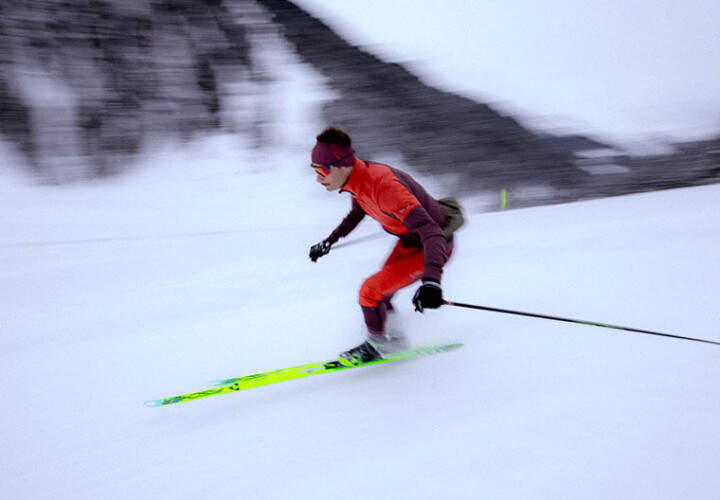
Women’s Cross-Country Ski Clothing: What You Actually Need, from Base Layer to Pants

LÖFFLER designs and manufactures cross-country ski clothing for women and men in Ried im Innkreis, Austria. Around 70% of the fabrics come from LÖFFLER's own knitting mill, including transtex® for the base layer. This guide is for women who train, tour or are just starting out on the trails. It shows you which five pieces you need and which ones you can skip.

The short answer

You need five pieces for cross-country skiing. A base layer, a jacket with a windproof front and cross-country pants or tights. Add gloves and a headband or hat. Below about −5 °C, or if you get cold easily, add a mid layer. Everything else is optional.

Key takeaway

Women’s cross-country ski clothing must be windproof at the front, breathable at the back and stretchy everywhere. Dress so that you feel slightly cold at the start. Ten minutes in, you will be comfortable.

Which pieces do you really need?

Cross-country skiing is a full-body endurance sport. You sweat on the climbs and cool down on the descents. Your clothing has to move sweat away from your skin and block the wind at the same time. Alpine ski wear can’t do that. It insulates for the chairlift, not for the trail.

Piece Essential or optional What it does
Base layer (top, long underwear when cold) Essential Moves moisture away from the skin
Cross-country ski jacket Essential Blocks wind at the front, lets vapour escape
Cross-country pants or tights Essential Freedom of movement, wind protection on the thighs
Gloves Essential Grip on the poles, warm fingers
Headband or hat Essential Protects ears and forehead from headwind
Mid layer below approx. −5 °C or if you run cold Insulation between base and outer layer
Vest optional Keeps your core warm, arms free
Insulated PrimaLoft® jacket optional Breaks, warm-up, the way home
Socks, neck tube, sports sunglasses optional Comfort below freezing, protection from snow glare
Base layer (top, long underwear when cold)
Essential or optional
Essential

What it does
Moves moisture away from the skin

Cross-country ski jacket
Essential or optional
Essential

What it does
Blocks wind at the front, lets vapour escape

Cross-country pants or tights
Essential or optional
Essential

What it does
Freedom of movement, wind protection on the thighs

Gloves
Essential or optional
Essential

What it does
Grip on the poles, warm fingers

Headband or hat
Essential or optional
Essential

What it does
Protects ears and forehead from headwind

Mid layer
Essential or optional
below approx. −5 °C or if you run cold

What it does
Insulation between base and outer layer

Vest
Essential or optional
optional

What it does
Keeps your core warm, arms free

Insulated PrimaLoft® jacket
Essential or optional
optional

What it does
Breaks, warm-up, the way home

Socks, neck tube, sports sunglasses
Essential or optional
optional

What it does
Comfort below freezing, protection from snow glare

1. Base layer: technical fabric, never cotton

Your base layer sits on your skin and controls your body climate. Cotton soaks up sweat and stays wet. On the next descent, evaporative cooling chills you fast. Synthetic or merino base layers move moisture to the outside instead.

transtex® uses polypropylene on the inside. The fibre absorbs almost no water. The knit structure moves sweat to the outer side mechanically, without chemical treatments.

  • Hard training above 0 °C → W Shirt L/S transtex® Light 100 (23144, EUR 54.99). Light, single layer, dries extremely fast.
  • Training and touring around −5 °C → W Shirt L/S transtex® Warm 180 (10745, EUR 69.99). Two layers, polypropylene inside, cotton/modal outside.
  • Easy pace in the cold → W Shirt L/S transtex® Merino 200 (27462, EUR 89.99). Polypropylene inside, merino wool outside, warm during breaks.
  • Very cold days below −10 °C → transtex® Warm 220 (30789, EUR 99.99) or transtex® Merino 260 (30793, EUR 119.99).

Above 0 °C, a transtex® Light 100 hipster (25598, EUR 34.99) is enough on the bottom. Below freezing, wear long underwear such as transtex® Warm 180 (10747, EUR 69.99). For the material comparison, read transtex® vs merino.

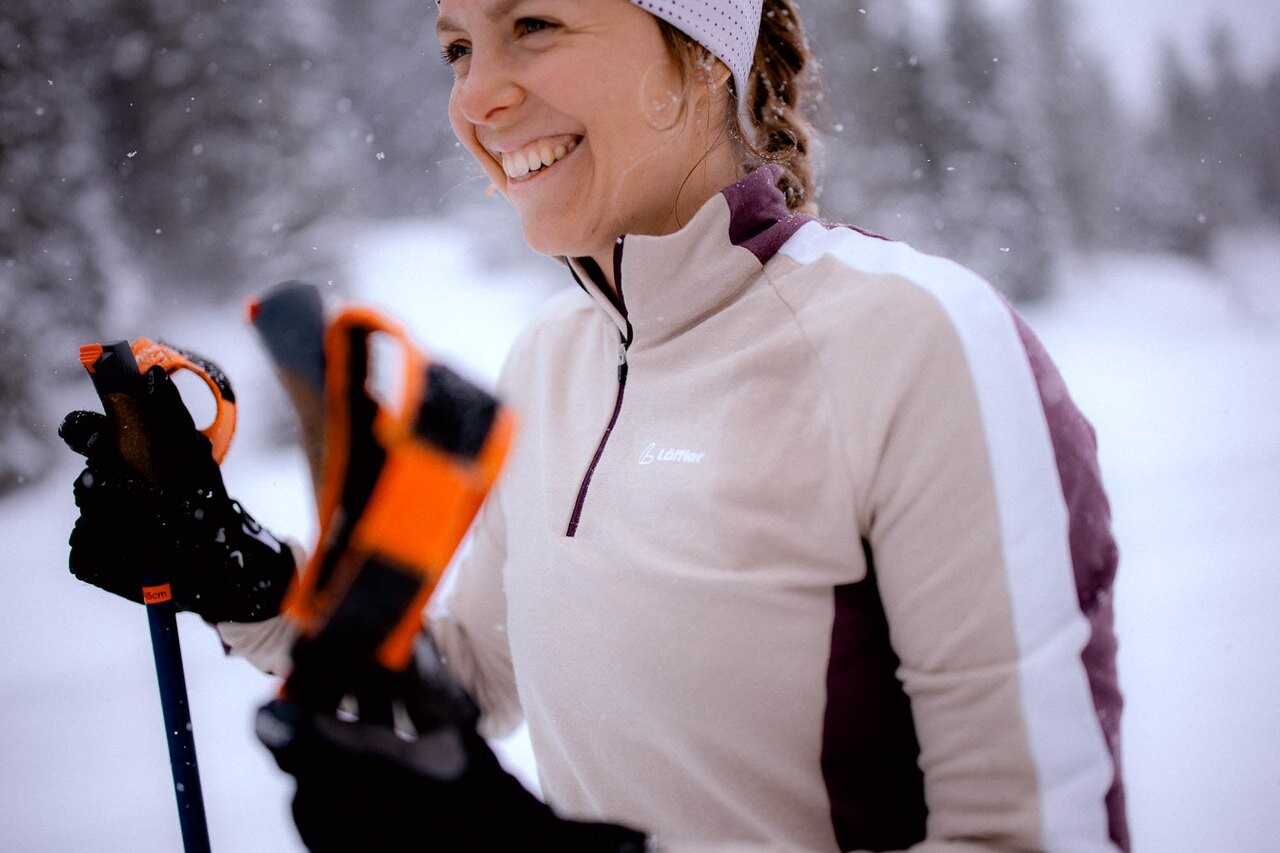
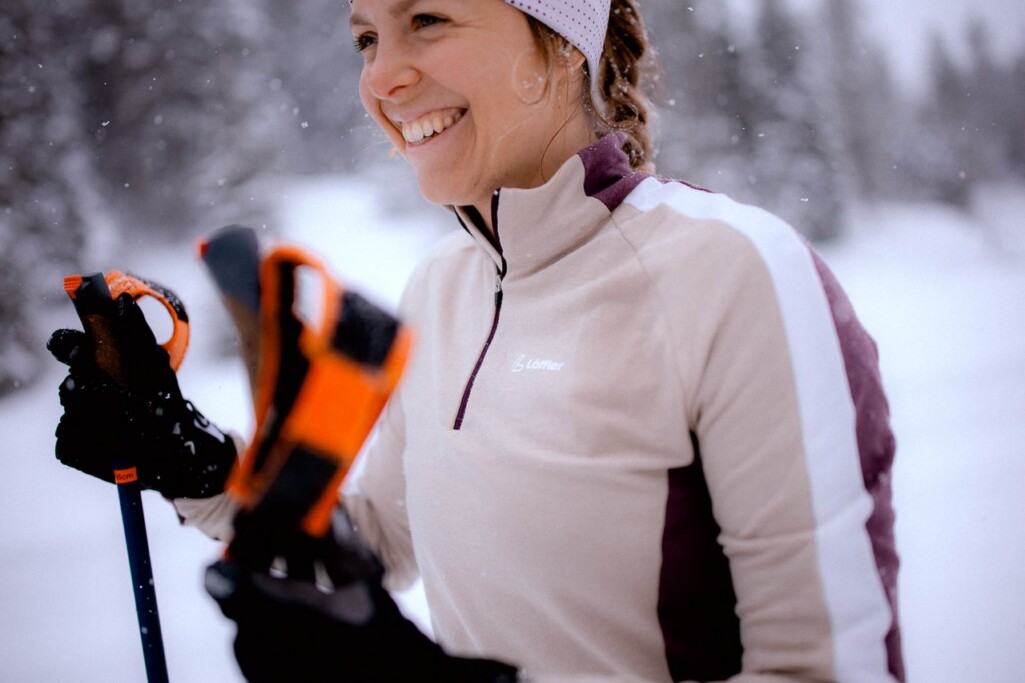
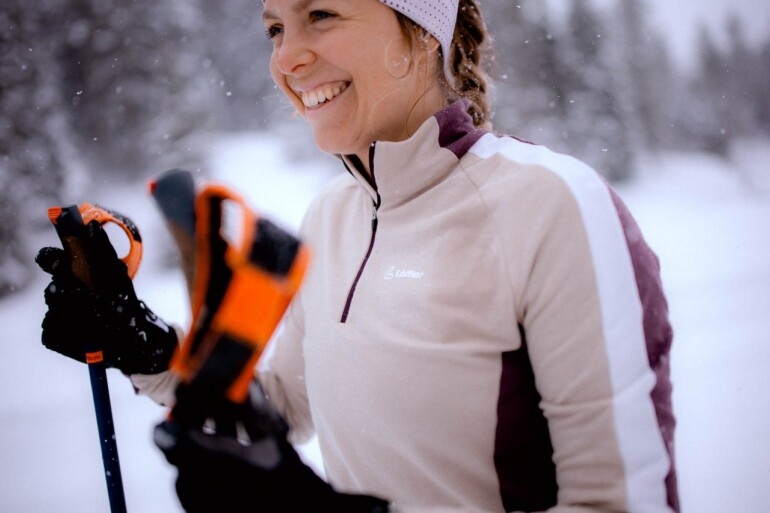
Smiling female cross-country skier in a beige and burgundy half-zip mid layer with headband and poles in falling snow Smiling female cross-country skier in a beige and burgundy half-zip mid layer with headband and poles in falling snow Smiling female cross-country skier in a beige and burgundy half-zip mid layer with headband and poles in falling snow Smiling female cross-country skier in a beige and burgundy half-zip mid layer with headband and poles in falling snow

70% of our fabrics come from our own knitting mill in Ried im Innkreis

2. Mid layer: insulation for cold days

The mid layer insulates and passes moisture on. You don’t need one above +5 °C. Below −5 °C it is a must. In between, your pace and how quickly you get cold decide.

  • High intensity → W Midlayer Motion (30872, EUR 119.99). Very stretchy with a fine spacer knit inside and thumb loops.
  • All-round below freezing → W Midlayer transtex® (10989, EUR 74.99) or W Midlayer Racing transtex® (30868, EUR 89.99).
  • Easy pace, maximum warmth → W Midlayer transtex® Merino (26266, EUR 99.99) or W Midlayer Fine transtex® Merino (30867, EUR 129.99).

3. Outer layer: the cross-country ski jacket

The jacket is your weather protection. When you glide, headwind hits you almost only from the front. Good cross-country jackets are windproof at the front and breathable at the back. This body mapping prevents overheating under the jacket.

LÖFFLER uses Airblocc for this. The 3-layer softshell is windproof, water-repellent thanks to a PFC-free DWR finish, and breathable. You only need a waterproof shell in rain or sleet.

  • Hard training → W Jacket Pro Breeze (30858, EUR 199.99). Race Elastic Warm with windproof Windshell on chest, shoulders and collar.
  • Training and touring → W Jacket Alpha AB Light (30072, EUR 179.99). Airblocc Softshell Light, the classic trail softshell.
  • Below −5 °C, easy pace → W Jacket Calida AB Warm (30075, EUR 239.99). Airblocc Warm with a fleece lining.
  • Changing conditions → W Zip-Off Jacket Vario AB Light (31170, EUR 239.99). Zip off the sleeves when it warms up.

Which jacket suits which temperature is covered in How to choose a women’s cross-country ski jacket.

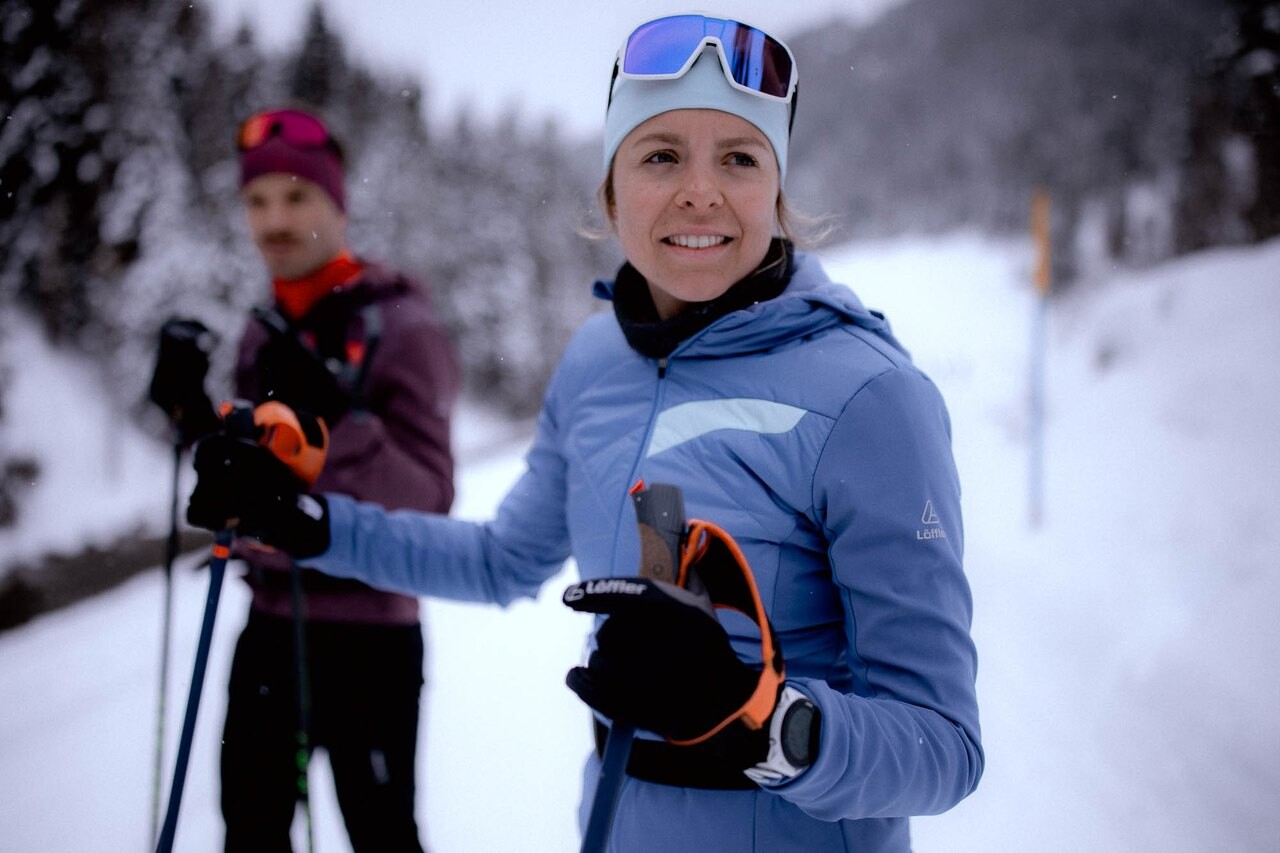
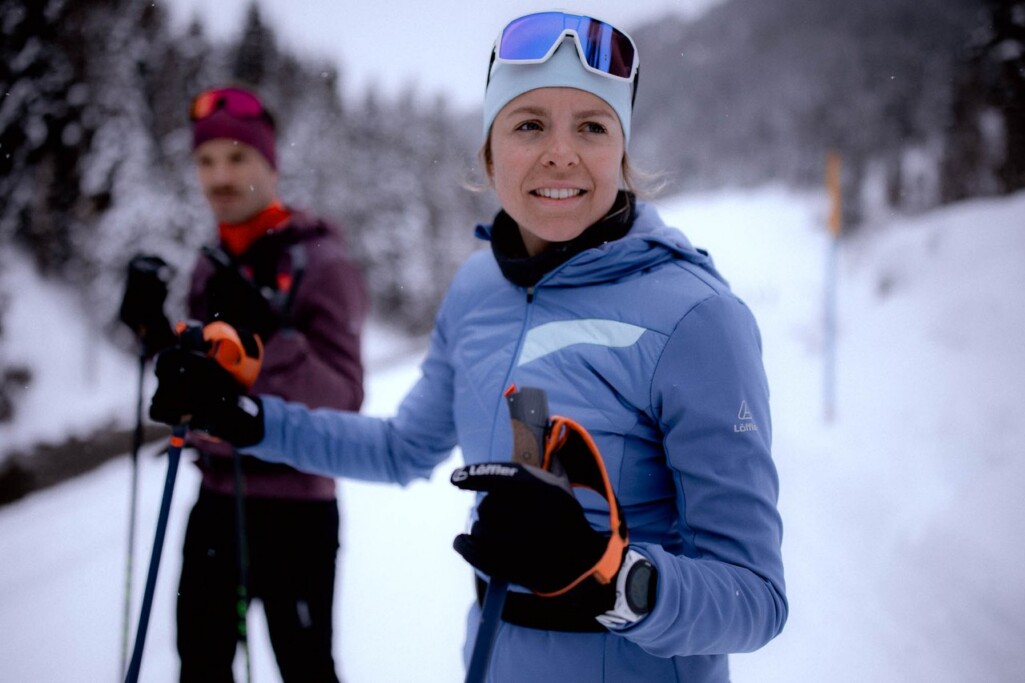
Female cross-country skier in a light blue hooded jacket and pale headband, a male skier behind her on the trail Female cross-country skier in a light blue hooded jacket and pale headband, a male skier behind her on the trail Female cross-country skier in a light blue hooded jacket and pale headband, a male skier behind her on the trail Female cross-country skier in a light blue hooded jacket and pale headband, a male skier behind her on the trail

4. Pants or tights

Skating and classic technique work your hips, knees and thighs constantly. Your pants need full freedom of movement and wind protection at the front. Tights fit close and don’t flap. Pants with a little more room are more comfortable for touring.

  • Hard training above 0 °C → W Tights Double Dry (31175, EUR 89.99). Very stretchy two-layer knit, dries fast.
  • Training at 0 to −5 °C → W Tights Pro Breeze (30860, EUR 199.99) or W Tights AB Light (30874, EUR 99.99).
  • Colder than −5 °C → W Tights AB Warm (30114, EUR 119.99). Airblocc Warm with thermal fleece inside.
  • Touring and beginners → W Pants Sport AB Light (30878, EUR 169.99). Softshell at the front, Double Dry at the back, leg zips.
  • Easy pace in the cold → W Pants Alaska ASW (23058, EUR 159.99).
  • Cold thighs → W Pants Gina ASW/PL (30876, EUR 169.99). Thighs insulated with 60 g PrimaLoft® GOLD.

More models and temperature ranges: Find the right cross-country ski trousers.

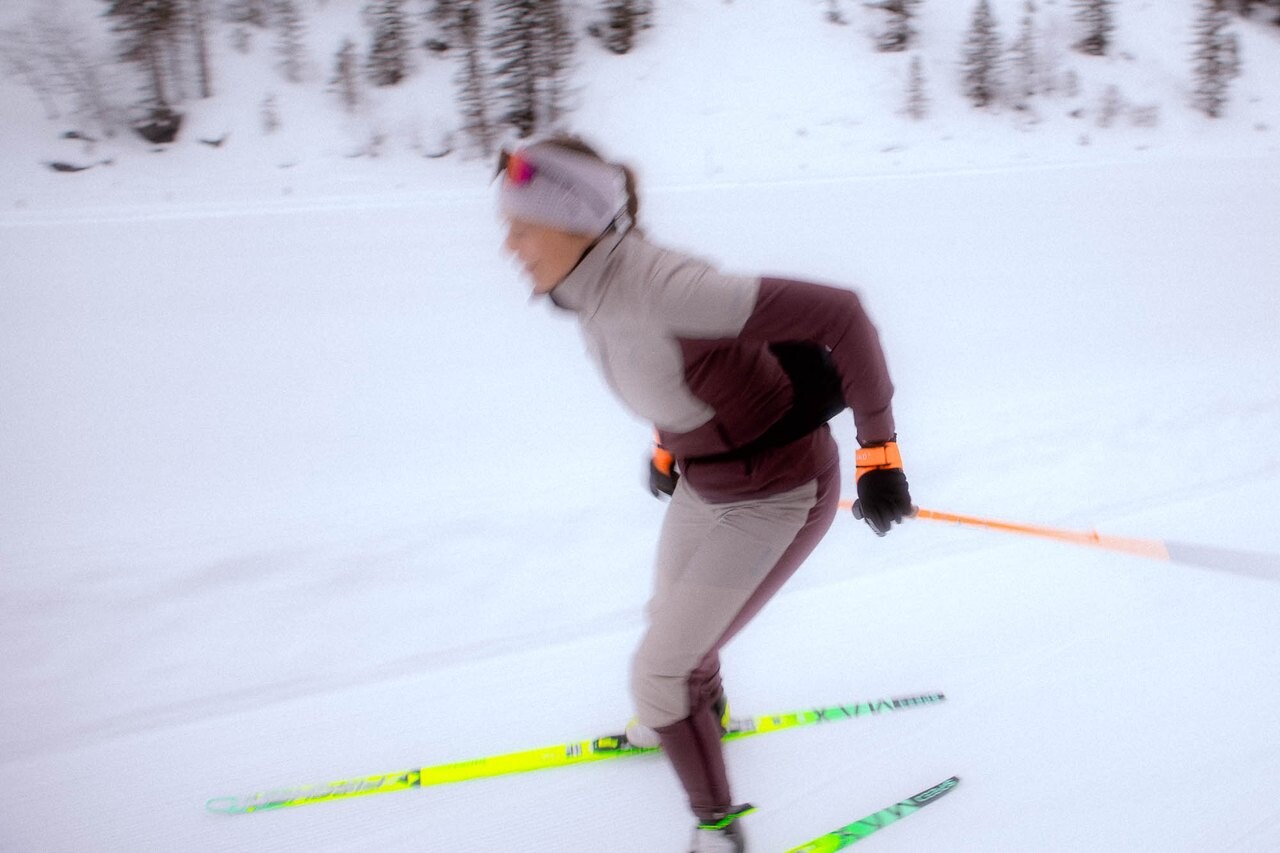
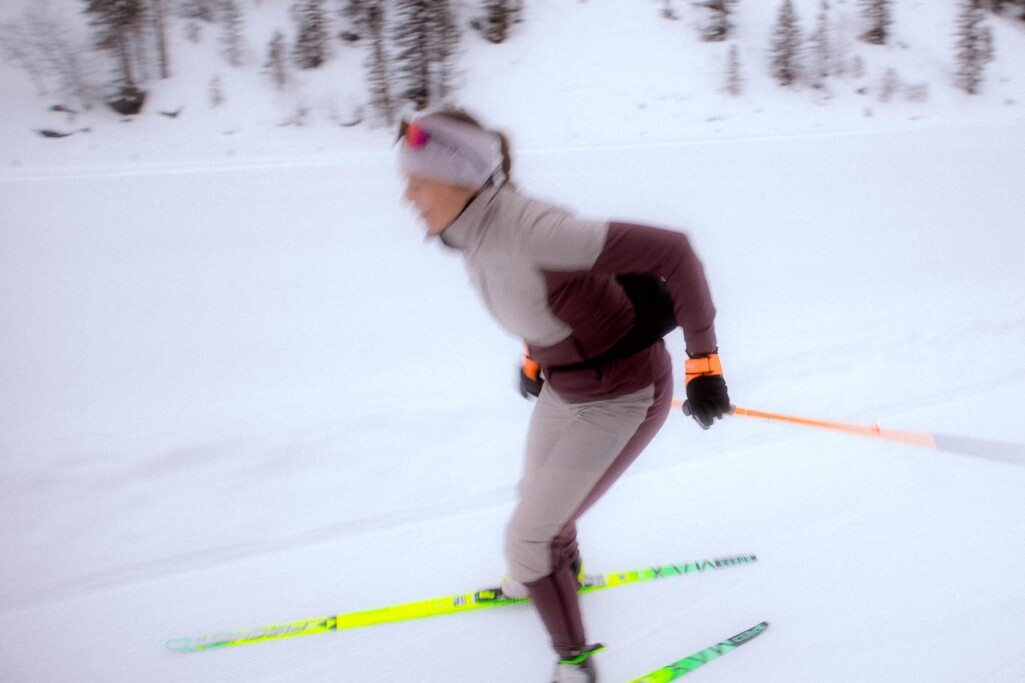
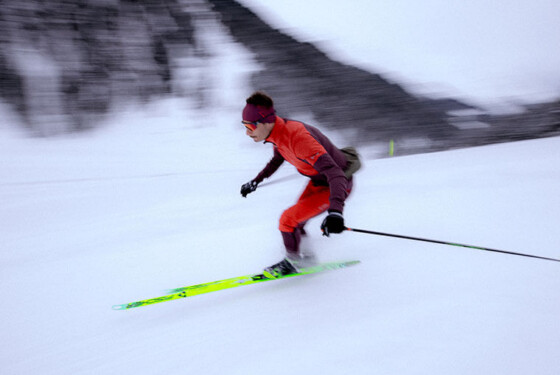
Female cross-country skier skating in motion, wearing a hybrid jacket and pants in beige and burgundy Female cross-country skier skating in motion, wearing a hybrid jacket and pants in beige and burgundy Female cross-country skier skating in motion, wearing a hybrid jacket and pants in beige and burgundy Female cross-country skier skating in motion, wearing a hybrid jacket and pants in beige and burgundy

5. Accessories: hands and head

Below freezing, your hands get cold first. Cross-country gloves must be thin enough for a secure pole grip and still block the wind.

  • Gloves → Windproof XC Gloves (30816, EUR 49.99). Windproof 3-layer softshell on the back of the hand. Above +5 °C, Thermo Gloves (26078, EUR 39.99) are enough.
  • Headband → Mono Headband (25064, EUR 22.99) or the wider Mono Headband Wide (25063, EUR 24.99).
  • Hat for windy days → Airblocc Hat (30172, EUR 39.99).
  • Wool hat for easy tours → Merino Wool Hat (26090, EUR 44.99).
  • Socks → transtex® Merino Socks (25512, EUR 19.99).
  • Neck → Multifunctional Merino Tube (26518, EUR 27.99).

Sports sunglasses protect your eyes from UV and snow glare. Choose a light tint for flat light.

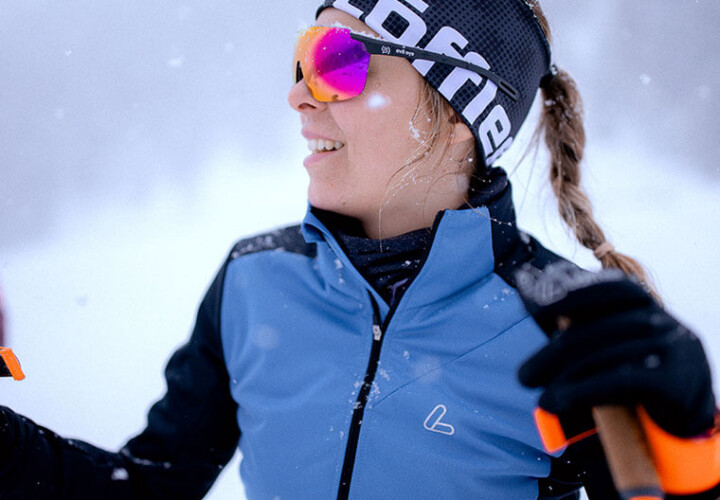
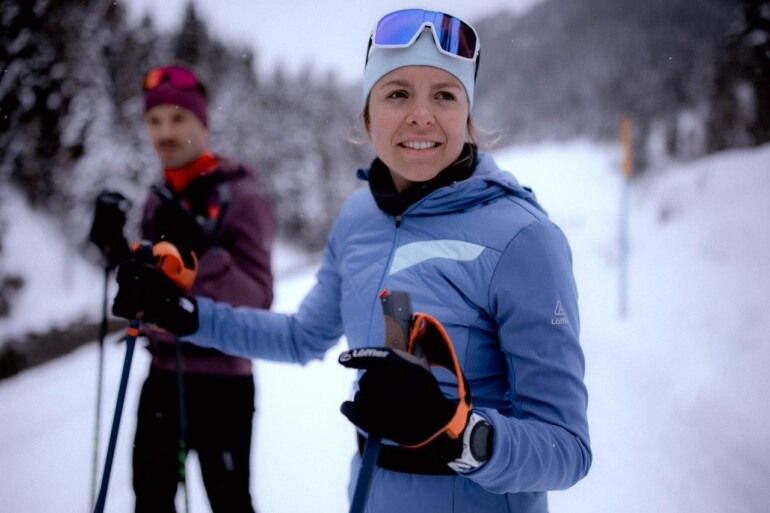
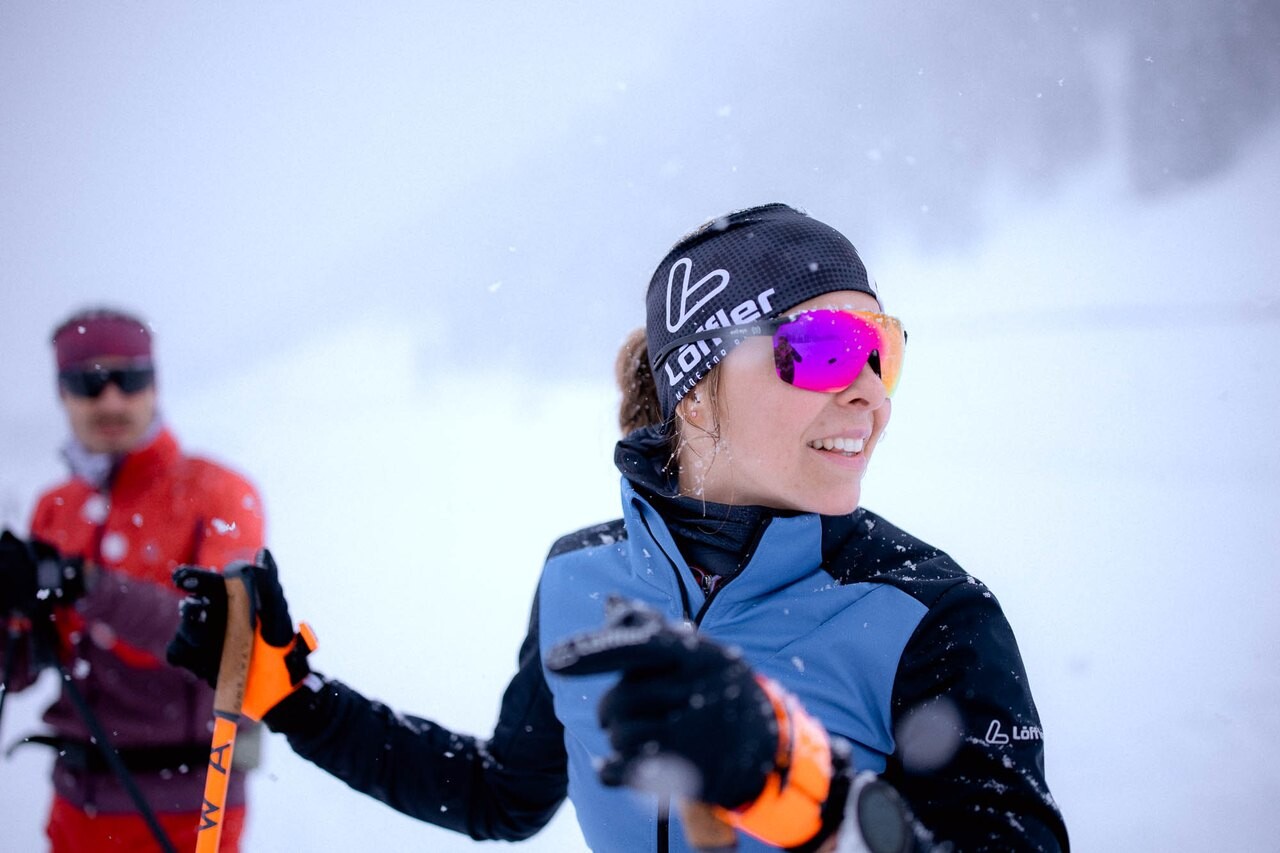
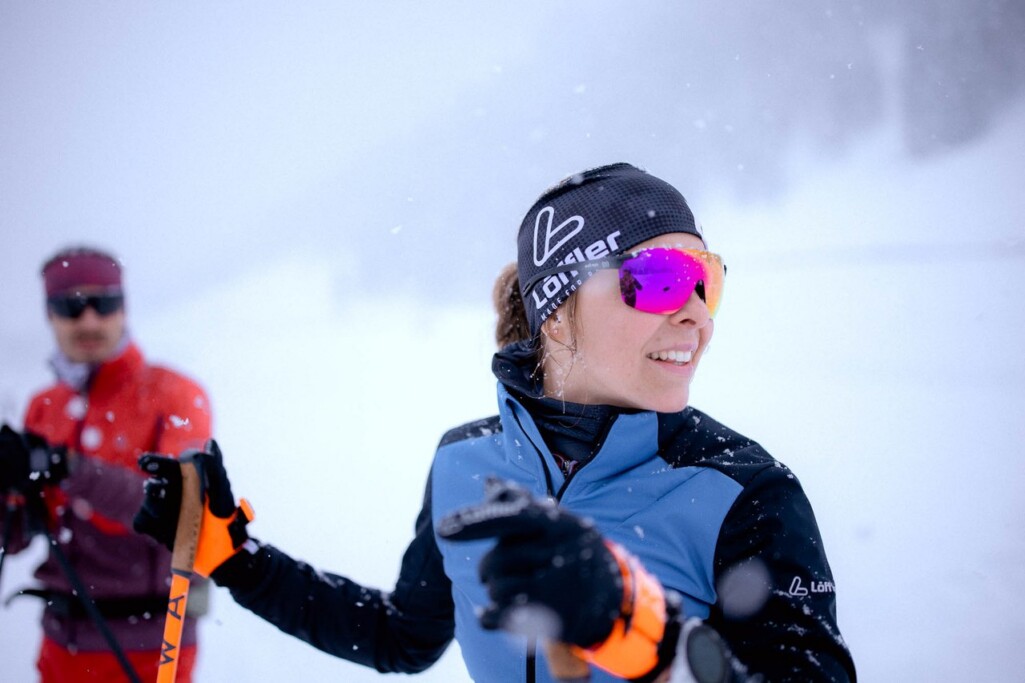
Female cross-country skier with a black LÖFFLER headband, sports sunglasses and a blue and black jacket in falling snow Female cross-country skier with a black LÖFFLER headband, sports sunglasses and a blue and black jacket in falling snow Female cross-country skier with a black LÖFFLER headband, sports sunglasses and a blue and black jacket in falling snow Female cross-country skier with a black LÖFFLER headband, sports sunglasses and a blue and black jacket in falling snow

What to wear by use: touring, training or racing

Intensity matters more than temperature. A hard skating interval produces far more heat than an easy classic tour through the forest.

Beginners and leisure skiers → warmth and comfort. You ski slower and take more breaks. Choose transtex® Warm 180 or Merino 200 and add a mid layer from 0 °C. On top, the Alpha AB Light and the Pants Sport AB Light work well. Pack an insulated vest for breaks.

Regular training → breathability before warmth. Choose transtex® Light 100, the Jacket Pro Breeze and the Tights Pro Breeze or Double Dry. Add a mid layer only below −5 °C.

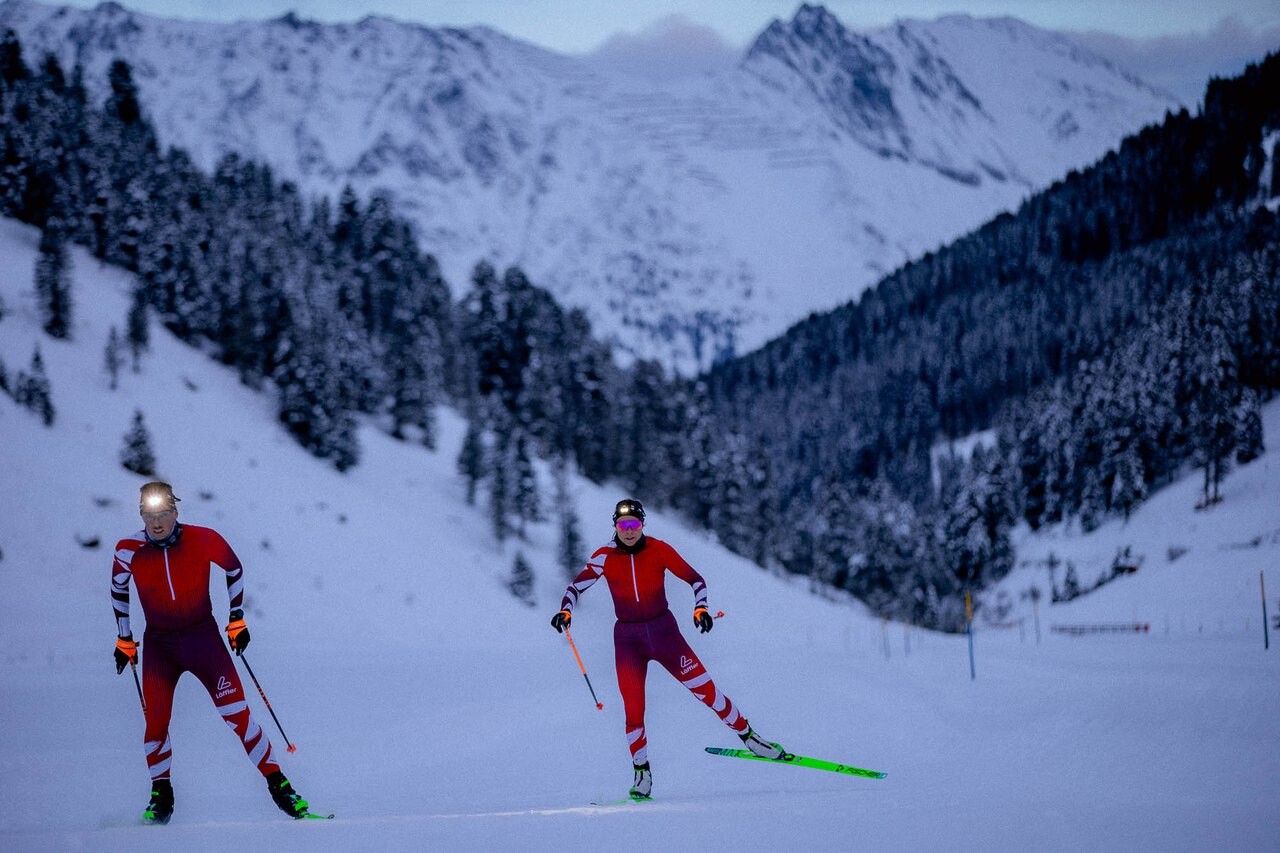
Racing → as little as possible. On race day you wear a race suit. The W Racesuite Pro 26 (30856) is a two-piece: top and long pants in Dimple Elastic with a Race Vent back. The set costs EUR 199.99. For warm-up, wear your jacket and pants over it. LÖFFLER has outfitted the Austrian Ski Federation (ÖSV) for decades.

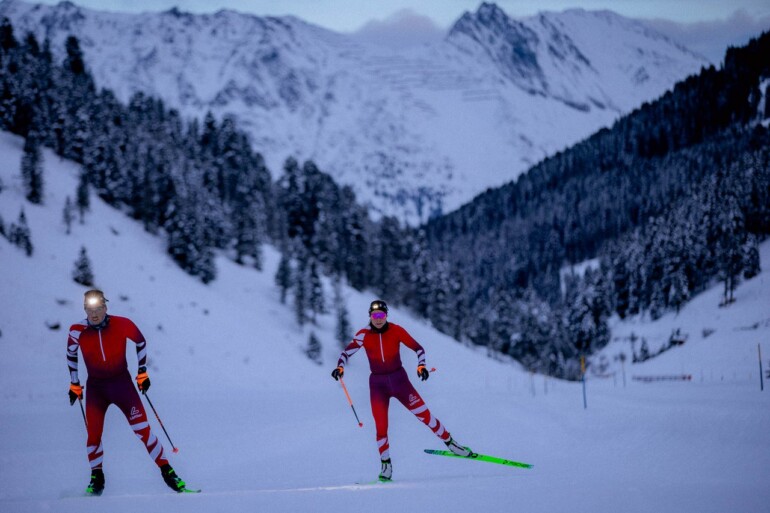
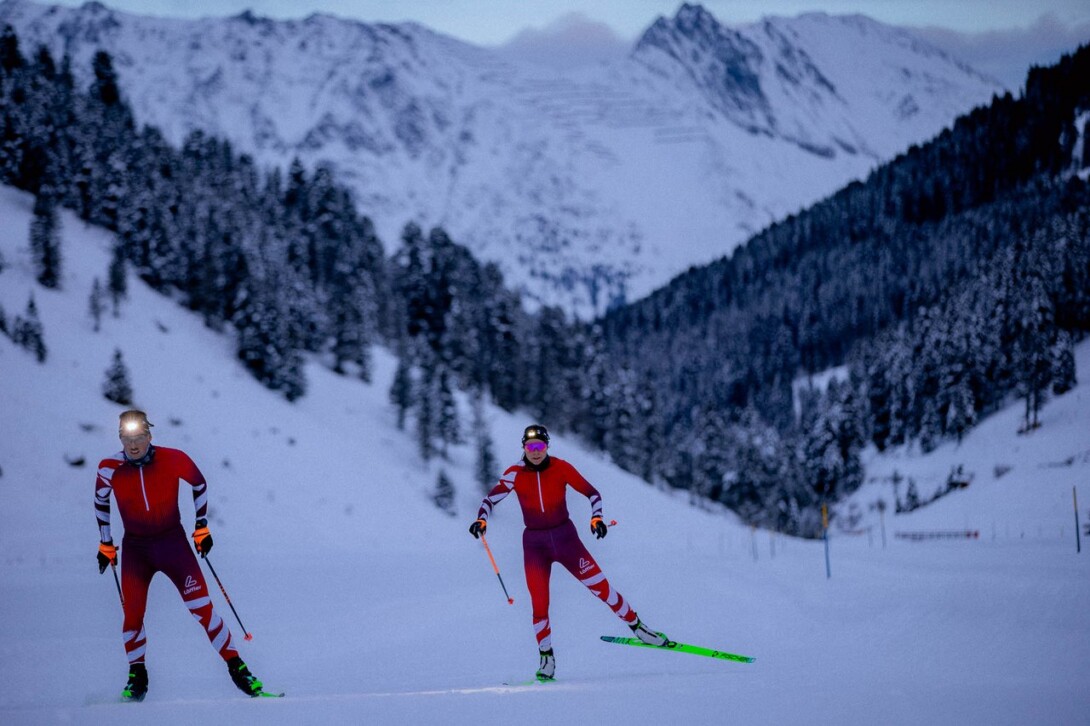
Female and male cross-country skiers in red and white race suits skating at dusk with headlamps, snowy mountains behind Female and male cross-country skiers in red and white race suits skating at dusk with headlamps, snowy mountains behind Female and male cross-country skiers in red and white race suits skating at dusk with headlamps, snowy mountains behind Female and male cross-country skiers in red and white race suits skating at dusk with headlamps, snowy mountains behind

Women’s cross-country ski outfit by temperature

Use this table as a guide for dry conditions. It matches the ranges in our jacket and pants guides. In wind, wet snow or if you get cold easily, go one step warmer.

Temperature Hard training (skating) Touring and easy pace (classic)
above +5 °C transtex® Light 100
W Vest AB Light or Jacket Pro Breeze
W Tights Double Dry
Thermo Gloves
headband
transtex® Light 100 or Merino Light 130
W Jacket Alpha AB Light
W Pants Sport AB Light
Thermo Gloves
headband
+5 to −5 °C transtex® Light 100
W Jacket Pro Breeze or Pro AB Ultra
W Tights Pro Breeze
Windproof XC Gloves
headband
transtex® Warm 180
W Midlayer transtex®
W Jacket Alpha AB Light
W Pants Sport AB Light or Elegance AB Light
Windproof XC Gloves
hat
−5 to −10 °C transtex® Warm 180
W Midlayer Motion
W Jacket Arrow AB Ultra
W Tights AB Light or AB Warm
Windproof XC Gloves
Airblocc Hat
transtex® Merino 200
W Midlayer transtex® Merino
W Jacket Calida AB Warm
W Pants Alaska ASW
Windproof XC Gloves
Merino Wool Hat
below −10 °C transtex® Merino 200
W Midlayer Racing transtex®
W Jacket Arrow AB Ultra
W Tights AB Warm
Windproof XC Gloves
Airblocc Hat
neck tube
transtex® Warm 220 or Merino 260
W Midlayer Fine transtex® Merino
W Jacket Calida AB Warm
W Pants Gina ASW/PL or Alaska ASW
Windproof XC Gloves
Merino Wool Hat
neck tube
above +5 °C
Hard training (skating)
transtex® Light 100
W Vest AB Light or Jacket Pro Breeze
W Tights Double Dry
Thermo Gloves
headband

Touring and easy pace (classic)
transtex® Light 100 or Merino Light 130
W Jacket Alpha AB Light
W Pants Sport AB Light
Thermo Gloves
headband

+5 to −5 °C
Hard training (skating)
transtex® Light 100
W Jacket Pro Breeze or Pro AB Ultra
W Tights Pro Breeze
Windproof XC Gloves
headband

Touring and easy pace (classic)
transtex® Warm 180
W Midlayer transtex®
W Jacket Alpha AB Light
W Pants Sport AB Light or Elegance AB Light
Windproof XC Gloves
hat

−5 to −10 °C
Hard training (skating)
transtex® Warm 180
W Midlayer Motion
W Jacket Arrow AB Ultra
W Tights AB Light or AB Warm
Windproof XC Gloves
Airblocc Hat

Touring and easy pace (classic)
transtex® Merino 200
W Midlayer transtex® Merino
W Jacket Calida AB Warm
W Pants Alaska ASW
Windproof XC Gloves
Merino Wool Hat

below −10 °C
Hard training (skating)
transtex® Merino 200
W Midlayer Racing transtex®
W Jacket Arrow AB Ultra
W Tights AB Warm
Windproof XC Gloves
Airblocc Hat
neck tube

Touring and easy pace (classic)
transtex® Warm 220 or Merino 260
W Midlayer Fine transtex® Merino
W Jacket Calida AB Warm
W Pants Gina ASW/PL or Alaska ASW
Windproof XC Gloves
Merino Wool Hat
neck tube

Women’s fit and layering

Women’s cross-country clothing is not a smaller men’s model. The cuts allow for narrower shoulders, a defined waist and more room at the hips. A close-fitting base layer is the only way to move sweat reliably.

Fit How it fits Best for
Tight fit close to the body, race-ergonomic, very stretchy Tights, race suit, high intensity
Slim fit body-hugging, sporty, defined waist Training jackets, mid layers
Mid fit a little looser, more room to move Touring, layering with a thick mid layer
Comfort fit straight cut, comfortable freedom of movement Leisure touring, everyday wear
Tapered fit relaxed waist, slim tapered legs Touring and leisure pants
Tight fit
How it fits
close to the body, race-ergonomic, very stretchy

Best for
Tights, race suit, high intensity

Slim fit
How it fits
body-hugging, sporty, defined waist

Best for
Training jackets, mid layers

Mid fit
How it fits
a little looser, more room to move

Best for
Touring, layering with a thick mid layer

Comfort fit
How it fits
straight cut, comfortable freedom of movement

Best for
Leisure touring, everyday wear

Tapered fit
How it fits
relaxed waist, slim tapered legs

Best for
Touring and leisure pants

Leg length. LÖFFLER’s women’s size chart is based on a height of 168 cm. Regular sizes have an inside leg of 79 to 81 cm. Selected pants also come in short sizes (75 to 77 cm) and long sizes (86 to 88 cm).

Plan for feeling the cold. Many women get cold hands, feet and lower backs sooner. If that’s you, dress one step warmer, roughly 3 °C. Choose merino in the base layer, add a mid layer from 0 °C and wear windproof gloves. Pants with an insulated front and a kidney warmer (01016, EUR 37.99) help on icy tours.

Layering. A slim-fit mid layer fits under any slim or mid-fit jacket. If you wear a thick mid layer, choose a mid-fit jacket. A tight outer layer compresses the insulation and reduces its warmth.

The 5 most common mistakes

1

Cotton as a base layer. It stays wet, and you get cold on the descent.

2

Alpine ski wear instead of cross-country clothing. It is built for the lift. On the trail you overheat.

3

Starting too warm. After ten minutes you sweat. Dress for moving, not for the car park.

4

Using running or cycling gear. Running jackets often lack front wind protection. Cycling shorts have a chamois that gets in the way.

5

No layer for breaks. You cool down fast after training. Pack a vest or insulated PrimaLoft® jacket.

Why LÖFFLER for women’s cross-country ski clothing

  • Own knitting mill: around 70% of the fabrics are knitted in Ried im Innkreis, including transtex®, Double Dry and Race Elastic.
  • Elite sport experience: LÖFFLER has outfitted the Austrian Nordic ski team for decades.
  • Women’s cuts: dedicated cuts for jackets, mid layers and pants in sizes 34 to 46, some up to 50.
  • Tested textiles: transtex® is certified to OEKO-TEX® Standard 100. The underwear lines transtex® Warm 220, transtex® Merino 260 and Merino Light 130 carry the OEKO-TEX® MADE IN GREEN label.
  • Repair service: LÖFFLER repairs garments at its headquarters in Ried.

FAQ: Women’s cross-country ski clothing

What cross-country ski clothing do women actually need?

Women need five pieces for cross-country skiing: a base layer, a jacket with a windproof front, cross-country pants or tights, gloves, and a headband or hat. Below about −5 °C, or if you get cold easily, add a mid layer. A vest, insulated jacket, neck tube and sports sunglasses are optional.

What should women wear for cross-country skiing at 0 °C?

For hard training at 0 °C, wear a transtex® Light 100 top and a jacket such as the Jacket Pro Breeze. Add tights with wind protection at the front, windproof gloves and a headband. At an easy pace, choose transtex® Warm 180, a mid layer and a softshell jacket such as the Alpha AB Light.

Do I need women-specific cross-country ski clothing?

Yes, it is worth it. Women’s cuts have narrower shoulders, a defined waist and more room at the hips. Only a close-fitting base layer moves sweat reliably, and only a well-fitting jacket seals at the collar and hem.

Can I wear alpine ski clothing for cross-country skiing?

Alpine ski clothing is too warm and not breathable enough for cross-country skiing. Ski jackets and ski pants insulate for standing in the lift queue. On the trail you move constantly and overheat. A light softshell jacket over a technical base layer is the better choice for beginners.

What helps if I get cold easily when cross-country skiing?

Dress one step warmer, roughly 3 °C. Choose a merino base layer such as transtex® Merino 200, add a mid layer from 0 °C and wear windproof gloves. Pants with an insulated front protect cold thighs. Pack a PrimaLoft® vest for breaks.

Tights or pants – which is better for beginners?

For beginners, pants with a little more room are usually the better choice, for example the Pants Sport AB Light. They have wind protection at the front, are comfortable and look casual. Tights pay off once you train regularly, faster, or skate.

How many layers should I wear for cross-country skiing?

Above +5 °C, two layers are enough: a base layer and a light jacket or vest. Between +5 and −5 °C, your pace decides whether you add a mid layer. Below −5 °C, wear three layers: base layer, insulating mid layer and windproof outer layer.

How much does a complete women’s cross-country ski outfit cost?

A basic LÖFFLER outfit costs around EUR 400. It includes the transtex® Light 100 top (EUR 54.99), Tights Double Dry (EUR 89.99) and Jacket Alpha AB Light (EUR 179.99). With Windproof XC Gloves (EUR 49.99) and a Mono Headband (EUR 22.99), the total is EUR 397.95. You can rent skis, but buy your clothing, because fit determines function.
Uncategorized
Men’s & Women’s Cross-Country Ski Trousers: How to Find the Right Trousers for Training and Touring

LÖFFLER designs and manufactures cross-country skiing trousers and tights for men and women in Ried im Innkreis, Austria, and is the official kit supplier to the ÖSV Nordic Team. The designs are aimed at cross-country skiers who train on the trails using the classic or skating style, or who enjoy leisurely cross-country tours. The hybrid construction makes all the difference: windproof Airblocc softshell or Windshell at the front, and breathable Double Dry or Thermo inner velour at the back. This means the trousers protect you where the wind hits and allow heat to escape where you sweat.

Read now
Tips
Choosing the right women’s cross-country skiing jacket: based on temperature, intensity and wind protection

LÖFFLER designs and manufactures women’s cross-country skiing jackets in Ried im Innkreis, Austria. As the official outfitter for the ÖSV Nordic division, we understand the demands of the cross-country trails from the world of elite sport. Our jackets are designed for female cross-country skiers who train, go on tours or compete in races. Airblocc softshell keeps the wind out at the front, whilst elasticated panels allow sweat vapour to escape – so you stay dry and don’t get chilled on the descent.

Read now
Tips
The best base layer for cross-country skiing: Which base layer is best suited to pace, cold weather and sweat?

The best base layer for cross-country skiing depends on the intensity of your activity, not just on the outside temperature.

Read now
Tips
Gravel biking for beginners: 5 essentials for your first ride

Gravel cycling involves changing conditions – from climbs to descents. With the right layering system, you’ll stay dry, protected and able to perform at your best in all weathers.

Read now
Tips
Road cycling kit for a cold start and a warm afternoon

On long days in the saddle, you’ll ride with a base layer (short-sleeved jersey, cycling shorts) and additional layers you can take off: arm warmers, leg warmers and a windproof vest. Whatever you need in the morning to stop yourself getting cold must fit into your jersey pocket by the afternoon, without you having to stop and change.

Read now